
The Story Behind Chattanooga's Fireman's Memorial Fountain
The Story Behind Chattanooga's Fireman's Memorial Fountain
A landmark most people pass without a second thought — and the remarkable history hiding in plain sight.
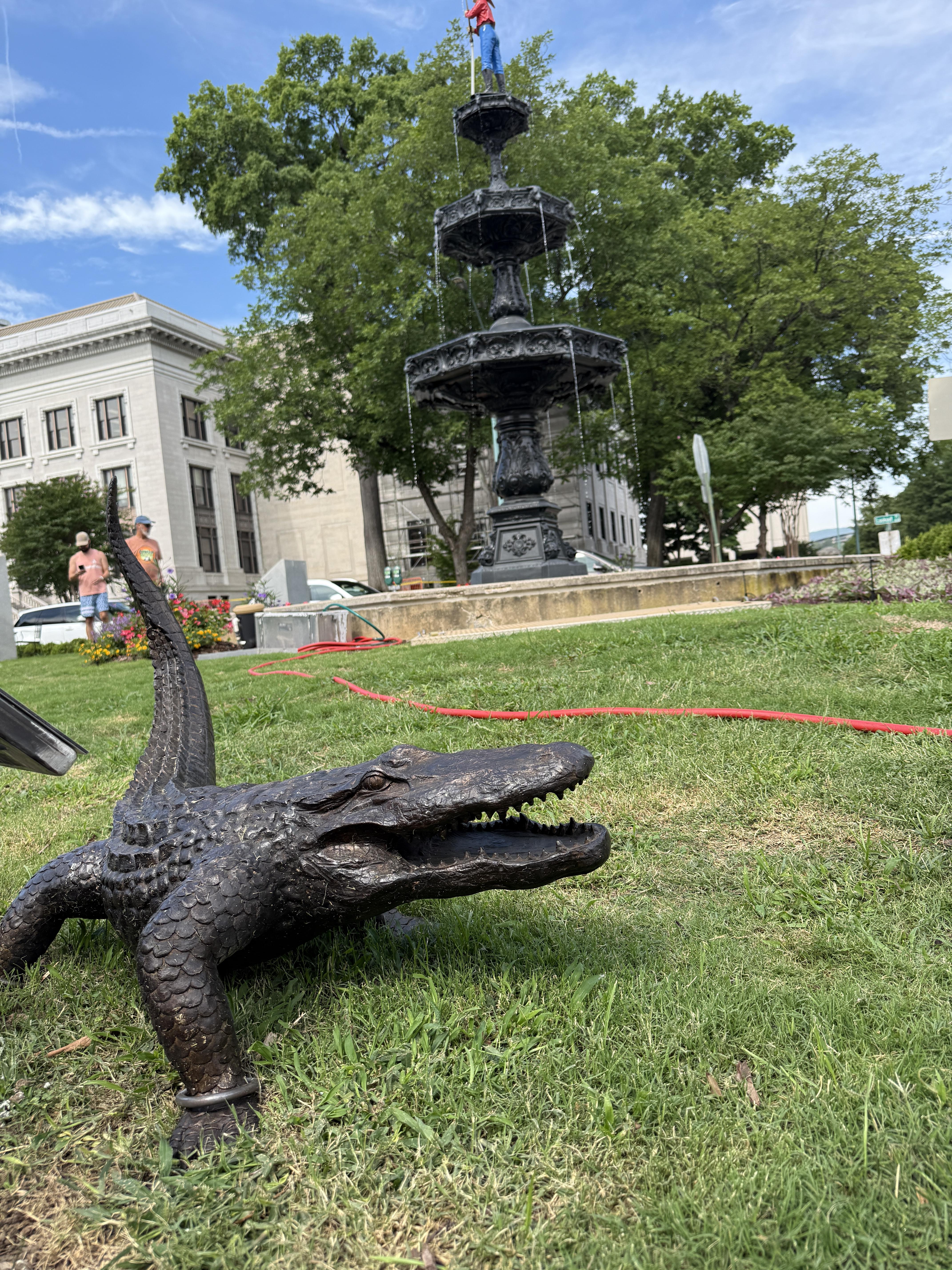
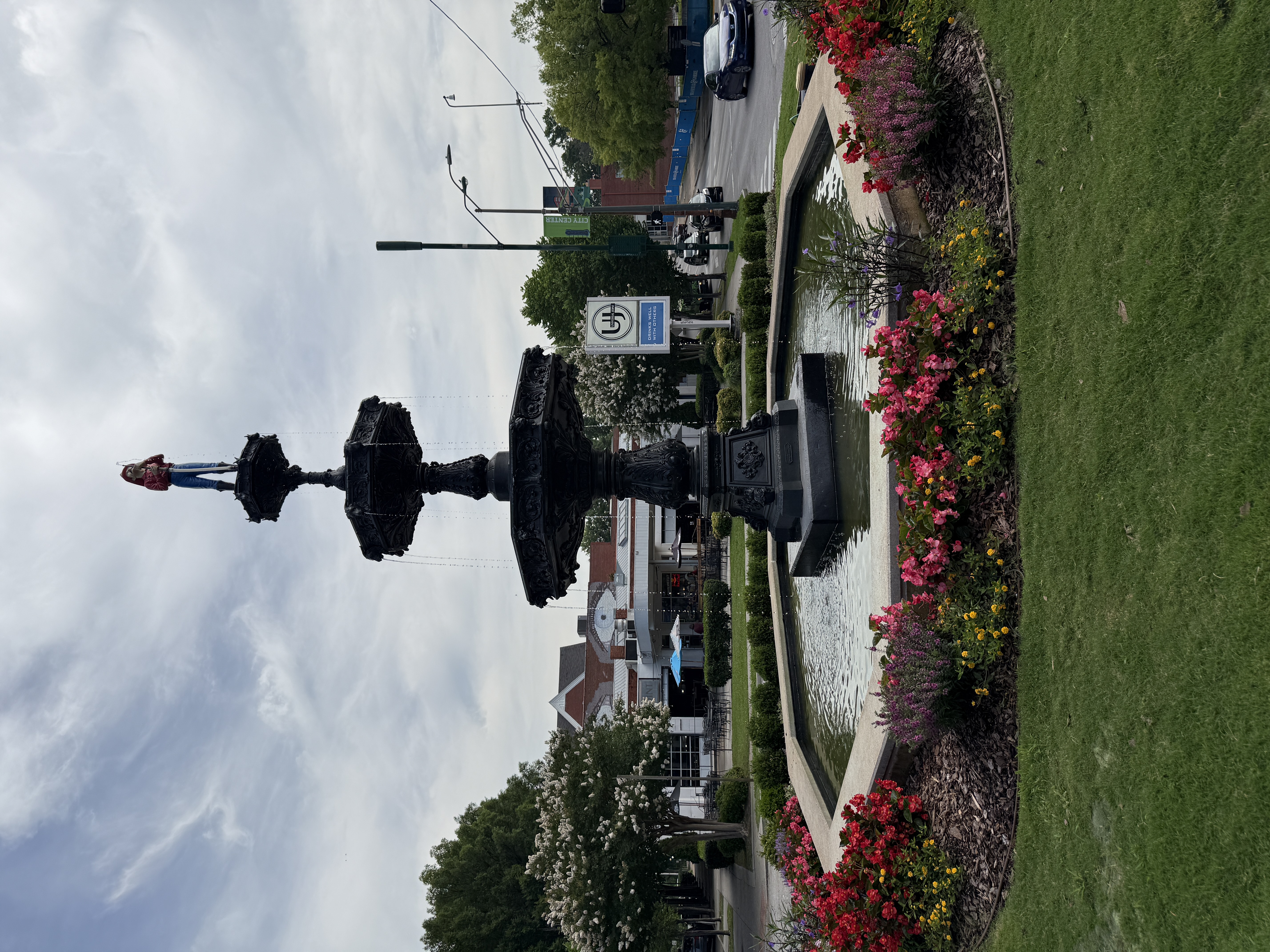
If you've spent any time in downtown Chattanooga, you've almost certainly walked past it. Tucked into a small triangular park where Georgia Avenue, Sixth Street, and Lookout Street meet, the Fireman's Memorial Fountain has been a quiet fixture of the Scenic City for nearly 140 years.
Most people glance at it and keep walking. But stop for a moment, and you'll find one of Chattanooga's most compelling stories, one of sacrifice, community, civic pride, and yes, even a pair of runaway alligators.
The Fire That Started It All
The story begins on June 9, 1887.
The Chattanooga Fire Department responded by horse-drawn engine to a massive blaze at the corner of Market and Fourth streets — a building known as the Bee Hive. During the fire, an explosion tore through the structure and a wall collapsed, trapping two firefighters: Henry Iler and William "Matt" Peak.
Chief Whiteside burned both hands badly as he frantically threw aside hot bricks trying to reach his men. Peak was pulled from the rubble alive but died three hours later. Iler died instantly.
They were young men. And Chattanooga was shaken.
"It shocked this community," local historian Linda Moss Mines has said, "because they realized how quickly doing good could turn into a tragedy."
A Community Responds
In the months that followed, the Chattanooga Daily Times led a fundraising campaign to honor the fallen firefighters. Citizens, businesses, and schoolchildren all contributed — a poem written by Florence Gerald, a theater actress performing in Chattanooga at the time of the fire, was printed and sold for 10 cents a copy, with proceeds going toward the memorial.
The city donated a plot of land at the intersection of Lookout, Sixth, and Georgia Avenue. The J.L. Mott Iron Company of New York was commissioned to design the fountain, and it was completed in 1888 — exactly one year after the fire.
The dedication ceremony on June 9, 1888 drew a crowd of over 2,000 citizens. City Attorney C.R. Evans, accepting the fountain on behalf of the mayor, captured the spirit of it perfectly:
"The fireman knows no hour of off-duty. By day and by night, in sunshine and in storm, he must be ready instantly to respond to the clanging alarm… so his figure in bronze here will stand at its post of duty in the light of day and in the darkness of night, in readiness to protect…"
Chief Whiteside's young daughter turned the water on. The crowd erupted. The Fireman's Memorial Fountain was born.
A Statue, Smashed and Reborn
The original figure atop the fountain was cast in zinc — a firefighter standing at attention, forever on duty. It stood for over 70 years before being vandalized and "smashed" in 1961. A polychromed aluminum replica was installed in 1962, and that figure stands there today.
It's a replica, but the spirit is unchanged. As one speaker said at the original dedication, the fountain was meant to stand as long as Chattanooga itself — "an emblem of this people's love for bravery, admiration for a duty well done."
For more on the fountain's design history and an incredible side-by-side of historic and modern photos, check out Chattanooga History's page on Fountain Square.
The Wildest Chapter: The Alligator Years
Here's the part of the story most Chattanoogans don't know.
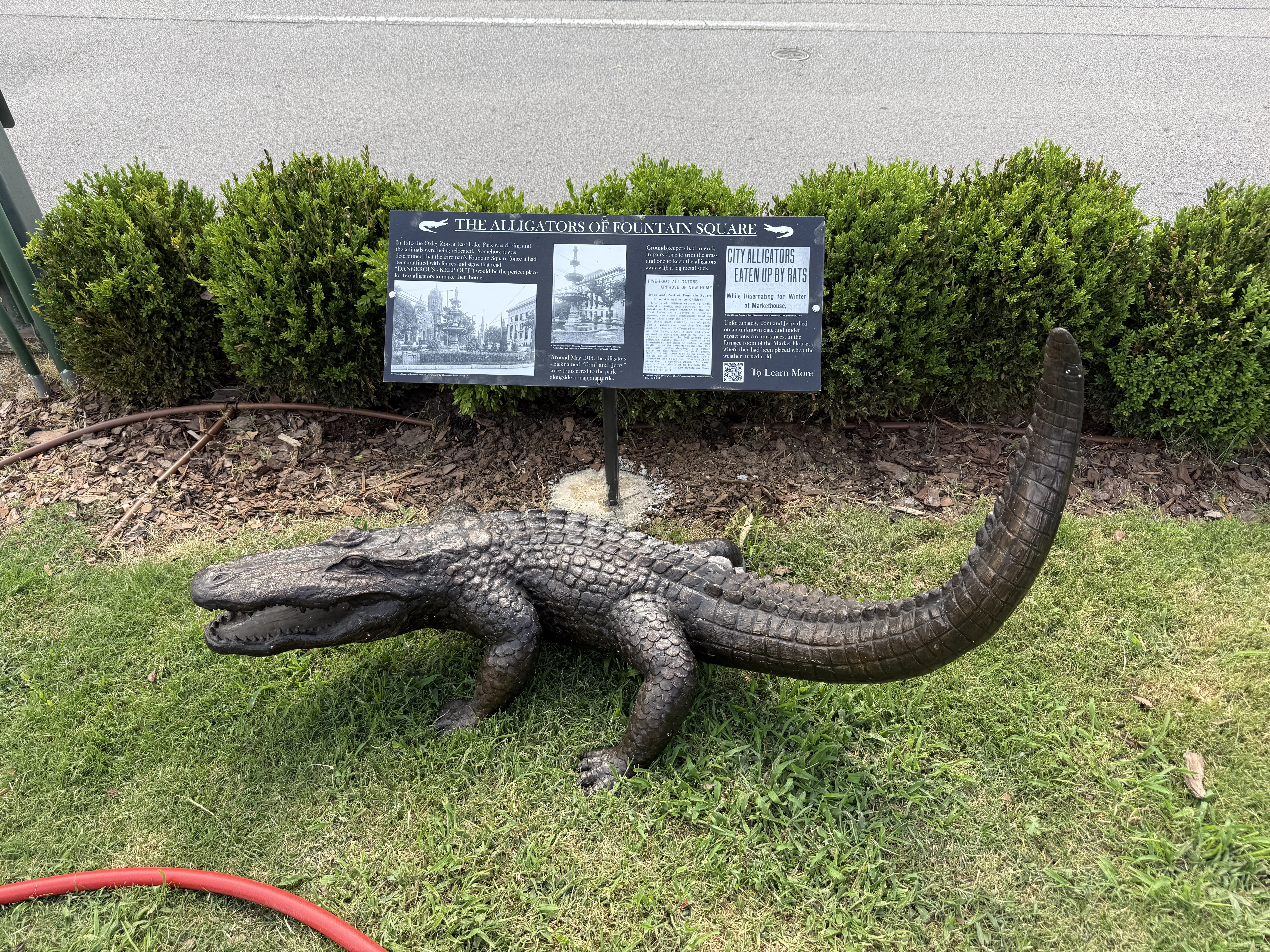
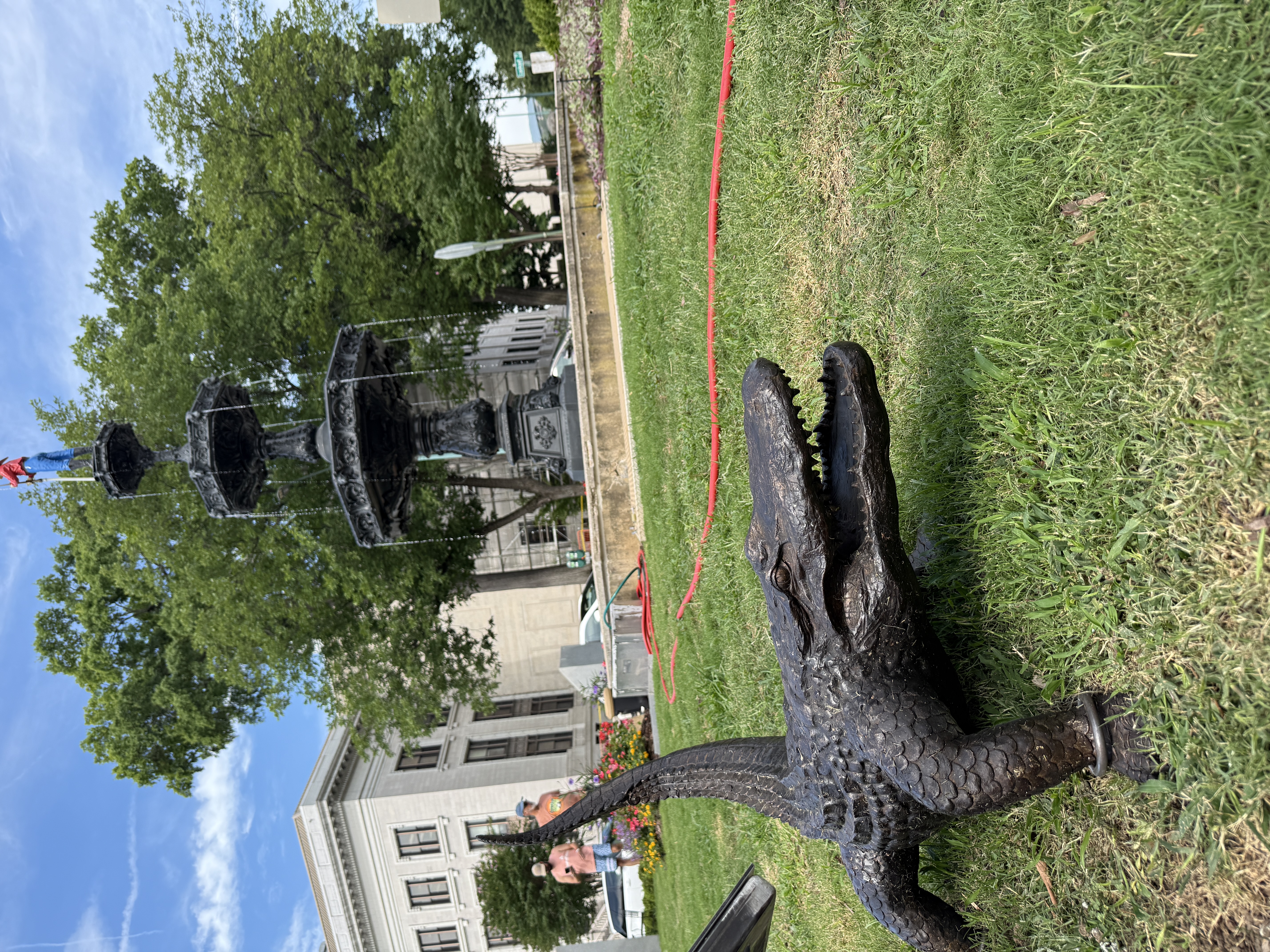
In the early 1900s, the fountain briefly became home to two live alligators.
No, really.
City officials — in a move that probably sounded reasonable at the time — decided alligators would be an ideal way to deter birds, dogs, and "vagrants" from the fountain. They were reportedly chosen for their supposed ability to eat only once a year, making them very cheap to maintain. (This, it turns out, was not true.)
The alligators were nicknamed Tom and Jerry. The fountain was surrounded by a low fence, and signs were posted reading: "DANGEROUS — KEEP OUT."
Periodically, Tom and Jerry would escape and roam downtown Chattanooga, which, as you might imagine, was not widely appreciated by residents.
Around May 1915, the alligators were transferred to East Lake Park Zoo — along with a snapping turtle, with whom they immediately got into a fight during transport. You really can't make this up.
The UTC Library has done a fascinating deep dive into the alligator chapter if you want the full story: The Alligator Guardians of Fireman's Fountain.
Still Standing — and Just Restored
The fountain hasn't always been well cared for. As early as 1906, a local business owner named J.C. Forstner publicly confronted the mayor about its deteriorating condition, calling it "a disgrace" at a city council meeting. Fertilizer had been dumped in the park. The fence was gone. The water hadn't worked in years. "What must a stranger think," he demanded, "when he sees it and then finds that it is a monument to the memory of two heroic firemen?"
The crowd, by all accounts, agreed.
That back-and-forth between neglect and renewal has continued for 135 years. But the most recent chapter is a good one: Hamilton County recently took ownership of the fountain from the city, sent it to Robinson Iron in Alexander City, Alabama for a full restoration, and has committed $175,000 to beautify the surrounding park.
Hamilton County Parks Director Matt Folz put it simply: "Over 100 years of legacy there. We just had to kind of give it a little bit of love."
Worth a Visit
The Fireman's Memorial Fountain sits at the corner of Georgia Avenue, Sixth Street, and Lookout Street — just steps from the Hamilton County Courthouse in the heart of downtown. It's free, it's beautiful, and now you know what it means.
Next time you walk past it, you'll see it differently.
Chattanooga Local covers the history, people, and places that make the Scenic City worth knowing. Explore more at chattanoogalocal.com.


